


Dust, News and Events, Safety
Controls Work When They’re Used: What NIOSH Measured, and Why Licensing Beats a Ban
Oct
California is close to deciding whether engineered stone can be fabricated at all.
Cal/OSHA has released a revised emergency draft that would ban fabrication and installation of artificial stone containing more than 1% crystalline silica. Each product would need a safety data sheet plus an accredited X-ray diffraction analysis to prove it is under the limit (Bloomberg Law). The September draft proposed:
- a ban starting 60 days after the rule takes effect
- a 180-day sell-through period for slabs already bought or contracted
- a new 3 µg/m³ action level for artificial stone
- respirators with an assigned protection factor of 1,000 for high-exposure tasks
(OHS Online). No Standards Board vote has been scheduled yet (Cal/OSHA).
The case for acting is serious, and nobody in our industry should pretend otherwise. Researchers have documented 592 cases of silicosis among California fabrication workers since 2019, with 65 lung transplants and 31 deaths (CIDRAP, citing NEJM Evidence). Many of those workers were young, and every case was preventable.
The question isn’t whether to act. It’s which action will stop the next case.
What NIOSH measured
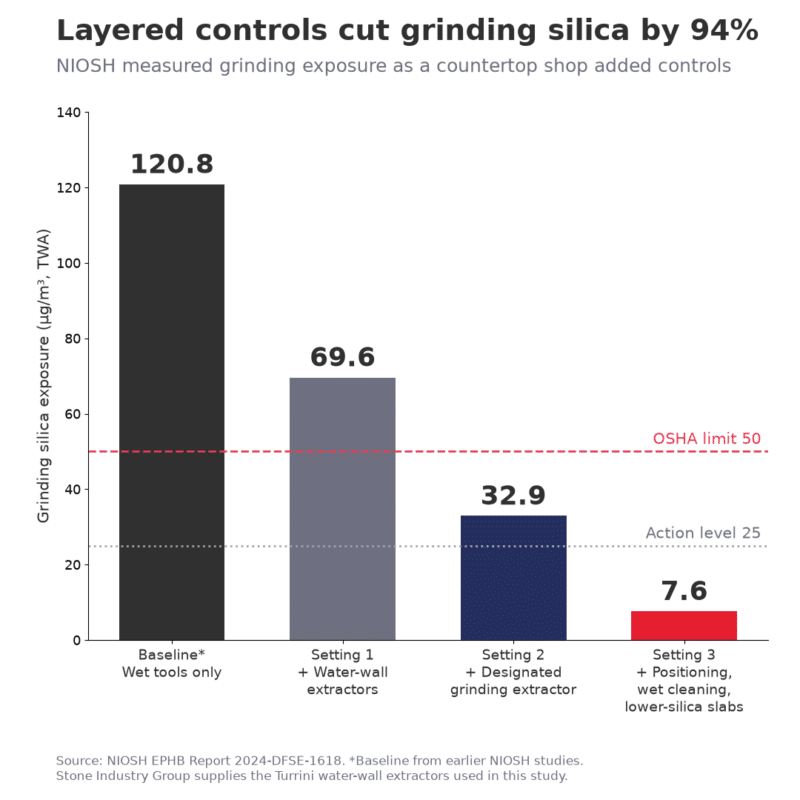
NIOSH’s engineering control study, report 2024-DFSE-1618, followed a countertop shop as it added controls in stages and measured respirable crystalline silica at each stage (NIOSH).
The evidence
NIOSH Report 2024-DFSE-1618: Engineering Controls for Engineered Stone Fabrication
The full field study behind the figures below. Layered controls brought grinding exposure down to 7.6 µg/m³ and polishing to 3.3 µg/m³.
Download the NIOSH report (PDF, 1.9 MB)
Also available from the CDC website.
| Setting | Controls in place | Grinding (µg/m³) | Polishing (µg/m³) |
|---|---|---|---|
| Comparison | Wet tools only (earlier NIOSH studies) | 120.8 | 14.4 |
| 1 | Plus water-wall extractors, fans and floor scrubbing | 69.6 | 47.8 |
| 2 | Plus a dedicated extractor at the grinding station and floor scrubbing every two hours | 32.9 | 42.9 |
| 3 | Plus training on where to stand, wet floor flushing every two hours and lower-silica slabs | 7.6 | 3.3 |
The federal permissible exposure limit is 50 µg/m³ and the action level is 25 µg/m³. In Setting 3, every result was below the action level.
Two points matter most. First, no single control did the job. Results improved step by step as controls were layered on, and polishing levels actually rose in the middle settings before the full package brought them down. Second, NIOSH concluded that the combination “consistently maintained individual RCS exposures to levels below the OSHA PEL for grinding and polishing tasks.” NIOSH also judged that exposures would have stayed below the limit even on the higher-silica material used in Setting 2 (NIOSH).
The joint NIOSH/OSHA hazard alert reaches the same conclusion. When engineering and administrative controls are used properly, “they are generally effective in reducing worker exposures below the OSHA PEL, and in some instances, to levels below the OSHA AL” (NIOSH/OSHA Hazard Alert 2026-101).
A word on the comparison row: it comes from earlier NIOSH studies of wet-tool-only shops, not from the same visits. It shows where shops relying on water at the tool alone typically land.
The real problem is enforcement
If controls work, why are workers getting sick? Because too many shops don’t use them.
Cal/OSHA’s own figures are the most widely quoted in this debate. Its evaluation of Petition 609 reports that it has cited 94% of the shops it inspected, and that 20% needed emergency shutdown orders (Cal/OSHA). In 2024 it carried out just 85 silica inspections (DIR).
Visits have undoubtedly increased since then. By 15 June 2026, Cal/OSHA had opened 192 inspections at countertop fabricators (RHP Risk, reporting to the Standards Board). Even so, that’s only around one in seven of the state’s estimated 1,342 shops, two and a half years into the emergency rules. Cal/OSHA’s own evaluation describes the pace as roughly one shop inspection a week (Cal/OSHA).
That isn’t evidence that controls fail. It’s evidence that unlicensed, unaudited shops can operate for years without anyone measuring the air.
A ban on one material doesn’t fix that. Shops that ignore the silica standard today will cut natural stone and other silica-bearing materials the same way tomorrow. Meanwhile the shops that have invested in proper extraction, water management and monitoring lose a large share of their work.
What the UK is doing differently
Britain faces the same problem and has chosen a different response. In May 2026 the Health and Safety Executive declared dry cutting of engineered stone unacceptable, published its first COSHH guidance written specifically for the material, and launched a programme of more than 1,000 fabricator visits across Great Britain (HSE).
The pace has been striking. In about five months of unannounced visits, HSE inspectors went into 434 businesses. 166 of them (38%) received legally binding enforcement notices, and 47 were ordered to stop the work immediately. HSE aims to have inspected all of the UK’s roughly 1,000 worktop fabricators by the end of March 2027 (The i Paper).
Those figures aren’t flattering: more than half the shops visited were in breach. But that is the point. HSE is finding the problems by walking through the door, and fixing them shop by shop, without banning the material. Its guidance requires:
- lower-silica stone
- on-tool water suppression
- mist control
- suitable respiratory protection
- regular health surveillance
(HSE). As HSE’s head of operations, Harvey Wild, put it: “It’s the best intelligence you’re going to get. We’re walking through the door and we’re seeing what’s there” (The i Paper).
In five months, the UK regulator has visited more than twice as many shops (434) as Cal/OSHA had opened inspections at (192) in the two and a half years to June 2026. Speed of enforcement, not prohibition, is what changes behaviour on the shop floor.
Licensing is the fix
California already has the foundations. SB 20 bans dry methods on high-exposure tasks. From 1 January 2027, it limits slab supply to fabricators that hold certification (CA Legislative Info).
The International Surface Fabricators Association has gone further. It has petitioned for a new section 5204.2 requiring each shop site to have:
- a licence
- an independent ISO 45001 audit
- workers’ compensation cover
- reporting to health surveillance
- stop-work orders when a shop fails (Stone Update)
The Natural Stone Institute has also asked Cal/OSHA to clarify the standards in the draft (Stone Update).
This is the approach the evidence supports. License the shops. Audit them. Measure the air. Cut off slab supply to any shop that fails, and close it if it doesn’t put things right.
Putting the risk in context
Risk numbers need care, so here is exactly what can and can’t be said.
OSHA’s 2016 silica rule estimated lifetime silicosis mortality at 7 deaths per 1,000 workers after a 45-year career at 50 µg/m³ (Federal Register, 81 FR 16576). Scaling that figure to the 7.6 µg/m³ NIOSH measured in Setting 3 gives roughly 1 per 1,000. For comparison, the US lifetime odds of dying in a motor-vehicle crash are about 1 in 95, or roughly 10 per 1,000 (National Safety Council).
On that basis, a worker’s modelled lifetime risk of dying from silicosis in a properly controlled shop is around a tenth of the risk we all accept on the road.
That comparison has limits, and we want to be straight about them. It covers silicosis only. Silica is also linked to lung cancer, kidney disease and other lung disease, and OSHA’s estimates for total silica-related deaths at the federal limit are considerably higher. OSHA’s model was built on older cohorts, and engineered stone silicosis can progress faster. Scaling the figure linearly is an approximation. None of this means all stone fabrication is safe. It means that a well-controlled shop is a very different place from an uncontrolled one, and that’s where regulation should focus.
What fabricators should do now
- Get recent personal air monitoring results for every role, starting with grinding and polishing.
- Collect an SDS and silica content figure for every slab in stock and on order.
- Check your SB 20 training attestation and how ready you are for certification.
- Review extraction at the grinding station, not just at the saw. That is where NIOSH found the largest gains.
- Treat wet cleaning and water management as controls in their own right. Dried slurry on floors and equipment puts silica back in the air.
Our position
We want every fabricator in California to go home healthy. We also want the shops that do this properly to keep working. The NIOSH data shows both are possible.
Disclosure: Stone Industry Group supplies T.C. Turrini Claudio water-wall dust extractors, the equipment used in the NIOSH study, together with Clearly closed-loop water treatment systems. We have a commercial interest in shops investing in controls. We think the evidence speaks for itself, and we’ve linked every source so you can check it, including a copy of the full NIOSH report.
If you’d like help reviewing your shop’s extraction, water management or monitoring, contact our US team on +1 (980) 466-9353 or at enquire@sig.ltd.
Simon Bradbury Chairman, Stone Industry Group
